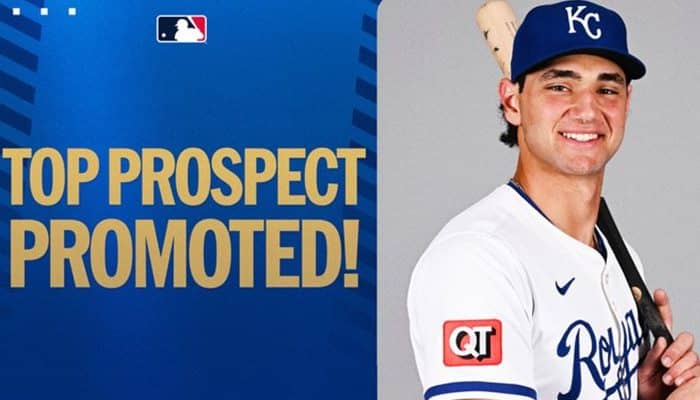
For a franchise in desperate need of an offensive jolt, the arrival of Jac Caglianone feels like a force of nature. Just 324 days after being selected with the sixth overall pick in the MLB Draft, the Kansas City Royals have called up their top prospect, a player whose raw power is so immense it borders on the mythical. “Cags,” as he’s known, is not just another promising young hitter; he possesses a rare, top-of-the-scale ability to impact a baseball with elite force, a quality that the struggling Royals lineup sorely lacks.
His rapid ascent through the minor leagues has been fueled by eye-popping exit velocities and a burgeoning legend. This deep-dive analysis explores the profile of the Royals’ new slugger, the reasons behind the immense hype, the questions he still needs to answer, and why his powerful bat was an absolute necessity for the big-league club.
The Power Profile: Hitting a Baseball Really, Really Hard
The foundation of the entire Jac Caglianone phenomenon is simple: he hits the baseball harder than almost any other human being on the planet. The data behind his power is not just impressive; it is historical. Earlier this season in the minor leagues, he recorded an opposite-field single with an exit velocity of 120.9 miles per hour. This is not just elite; it is rarefied air. Since the Statcast era began, only a handful of the sport’s most legendary power hitters—a list that includes Giancarlo Stanton, Aaron Judge, and Vladimir Guerrero Jr.—have ever recorded a batted ball that hard. To generate that kind of force, especially as a 21-year-old, is a clear indication of a truly special physical gift.
This is the offensive ceiling that has scouts and analysts so excited. While still in college, Caglianone was already a legend for his light-tower power, slashing a ridiculous .419/.544/.875 with 35 home runs in his draft year at the University of Florida. He has carried that production directly into professional baseball, posting a .593 slugging percentage with 15 home runs across Double-A and Triple-A this season. He generates this incredible pop with a wonderful combination of looseness and explosive strength in his hands and wrists. This is the kind of game-altering, top-of-the-scale power that cannot be taught, and it’s the single biggest reason the Royals believe he can be a franchise cornerstone for years to come.
The Prospect Profile: From High-Risk Pick to Fast-Rising Star
Despite his immense power, Caglianone was not considered a “can’t-miss” prospect heading into the draft. In fact, many teams viewed him as a high-risk “boom-or-bust” talent. The primary concern was his plate discipline. At the University of Florida, he was known for being an aggressive, free-swinging hitter, with an out-of-zone chase rate that was a significant red flag for professional scouts. There were legitimate worries about how his approach would translate against the more advanced and disciplined pitching he would face in pro ball.
However, since joining the Royals organization, Caglianone has made significant strides in this area. Through professional coaching and slight mechanical adjustments, he has managed to lower his chase rate to a level that, while still aggressive, is no longer in the panic-inducing range. His current chase rate profile is comparable to that of established MLB stars like Bryce Harper and Corbin Carroll, as well as another exciting young slugger in Junior Caminero of the Tampa Bay Rays. This rapid improvement in his swing decisions is a hugely encouraging sign. It shows a willingness to learn and adapt, and it has transformed him from a high-risk gamble into one of the fastest-rising and most exciting prospects in all of baseball.
The Two-Way Phenom That Wasn’t: A Future in the Batter’s Box
Much of the national buzz surrounding Caglianone during his college career stemmed from his exploits as a two-way player, drawing not-so-subtle comparisons to Shohei Ohtani and earning him the nickname “Jac-tani.” The ability to touch 99 miles per hour as a left-handed pitcher while also being one of the most feared power hitters in the country made him a true college baseball unicorn. The combination of skills he possessed was almost unheard of.
However, despite the Royals announcing him as a two-way player on draft day, it was an open secret within the industry that his professional future was always going to be exclusively as a hitter. While his eye-popping velocity on the mound was impressive, the rest of his pitching profile—his secondary pitches, his command, and the overall shape of his fastball—left much to be desired. Talent evaluators universally agreed that while his ceiling as a pitcher was limited, his ceiling as a hitter was stratospheric. The Royals wisely decided to have him focus all of his energy on what he does best: hitting the baseball with incredible force. So far, that decision has paid off spectacularly.
Finding a Position and Answering a Need
With his future firmly established as a hitter, the next challenge for Caglianone and the Royals has been finding him a defensive home. A first baseman for most of his college career, he found his path to the big leagues at that position blocked by the established Vinnie Pasquantino and the iconic Salvador Perez, who often occupies the designated hitter spot. To get his powerful bat into the lineup as quickly as possible, the Royals transitioned Caglianone to the outfield during his time in the minors.
He is still considered a work in progress defensively, but he is athletic enough to be a passable corner outfielder. The reality is that his defensive profile is secondary; his bat is so potentially transformative that the Royals simply had to find a way to get him into their lineup. The timing of his promotion is no coincidence. The Royals’ offense has been one of the least productive in the league this season, ranking near the bottom in home runs, walk rate, and runs scored. Outside of MVP candidate Bobby Witt Jr. and third baseman Maikel Garcia, the lineup has been starved for production. The promotion of Jac Caglianone is not just a reward for his excellent minor league performance; it is an act of necessity, a desperate injection of elite power into a lineup that needs a major jolt.