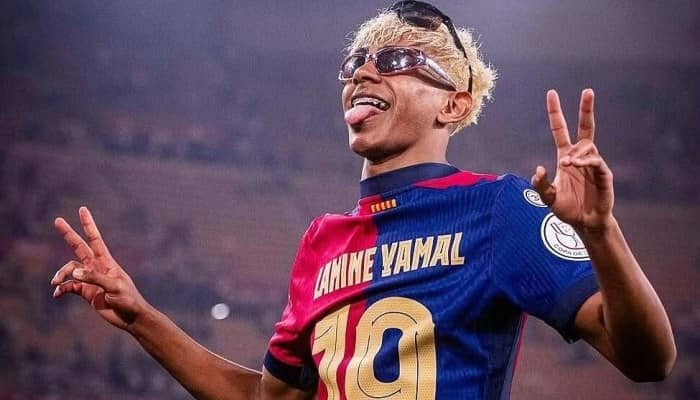
In the aftermath of any major final, the narrative often splinters. For the victors, there is glory; for the losers, scrutiny. Following Spain’s narrow UEFA Nations League final defeat to Portugal, a predictable wave of criticism was aimed at their teenage prodigy, Lamine Yamal. For those who had grown tired of the “overhype,” it was a moment to cut the 17-year-old down to size. But to view this setback as a failure is to fundamentally misunderstand the psychological DNA of a budding genius.
This defeat, and the derision that follows, will not break him. On the contrary, it will serve as the rocket fuel for the next stage of his evolution. History has shown us that the greatest athletes of all time, like Lionel Messi and Cristiano Ronaldo, were not defined by their talent alone, but by how they responded to their earliest and most painful setbacks. The football world should be warned: the defeat was not an ending, but the beginning of the creation of a competitive monster.
The Common DNA of Greatness: The Power of Adversity
What separates the good from the great, and the great from the legendary, is rarely technical ability alone. At the highest level of sport, almost everyone is talented. The defining characteristic of the true greats is a ferocious, almost pathological, competitive mentality—an “I’ll show you” determination that is forged in the fires of disappointment. These athletes possess a unique ability to absorb setbacks, mockery, and criticism and metabolize it into motivational fuel.
They store away every slight, every doubt, and every defeat, using them to power their relentless pursuit of dominance. This is not a learned trait; it is an innate part of their character. The careers of the two players who have defined the 21st century, Lionel Messi and Cristiano Ronaldo, provide the perfect blueprint for how this process works. Both endured significant early-career adversity that proved to be the crucible in which their legendary mentalities were forged.
The Messi Blueprint: How a Final Snub Created a Legend
In the spring of 2006, an 18-year-old Lionel Messi was on the cusp of his first major European trophy. His Barcelona side had reached the Champions League final against Arsenal. After a long recovery from a hamstring injury, Messi was convinced he was fit and ready to play a part. However, his coach, Frank Rijkaard, made the stunning decision to leave him out of the matchday squad entirely. As his teammates celebrated their 2-1 victory on the pitch at the Stade de France, a furious Messi refused to leave the dressing room to join them. Not even the coaxing of his mentor, Ronaldinho, could change his mind. His trademark stubbornness had taken hold.
Weeks later, a more reflective Messi admitted his mistake. “I was furious. I was really overcome,” he said. “I made a bad choice, but I’ve learned from it.” He learned more than just how to celebrate with his team; he learned how to channel that intense fury into on-pitch performance. That singular event, the feeling of being overlooked on the biggest stage, ignited a fire in him that would burn for the next two decades. He used that pain to drive himself to unprecedented heights, ensuring he would never again be a spectator when the biggest trophies were on the line. The snub did not break him; it built him.
The Ronaldo Transformation: From Mockery to Unstoppable Force
Cristiano Ronaldo’s story follows a similar arc. When he arrived at Manchester United as a wiry, flashy teenager, he was met with a harsh dressing room culture. Senior teammates mercilessly teased him for everything from his fashion choices and his imperfect complexion to his on-pitch decision-making. The legendary striker Ruud van Nistelrooy, in particular, grew intensely frustrated with the young winger’s unwillingness to cross the ball. These experiences, by Ronaldo’s own admission, often reduced him to tears.
But like Messi, he did not crumble. Instead, he absorbed every piece of mockery and used it as motivation. Those who were there at the time recall watching him transform himself through sheer force of will. He used the criticism to become a ruthlessly efficient team player and the physical jibes to build himself into one of the most dominant athletic specimens the sport has ever seen. The boy who was teased became a terrifyingly dominant team leader, first at United, then at Real Madrid, and for his country. He proved that for a certain type of personality, derision is not a deterrent; it is a catalyst.
Yamal’s Ignition Point: The Rocket Fuel for 2025-26
This brings us back to Lamine Yamal. At just 17, he has now experienced his first major international final defeat. While he was influential in the match, the result and the narrative focus on the victor, Cristiano Ronaldo, will sting. The inevitable criticism from pundits and social media, coupled with the likelihood of being pipped to the Ballon d’Or by players from the treble-winning PSG side, will provide him with his own unique cocktail of motivational fuel. Like Messi and Ronaldo, this street-smart competitor will now nurse his wrath.
While his main Ballon d’Or rivals embark on draining, commercially-driven summer tours, Yamal will rest, recuperate, and celebrate his 18th birthday. This will be his first real opportunity to assimilate the extraordinary experiences of the past year since he broke into the Barcelona first team as a 15-year-old. He will watch, he will listen to the criticism, and he will plan his assault on the 2025-26 season. He already possesses the defiant mentality, once telling critics, “As long as I win, you can’t say anything to me.” Now, having experienced a high-profile defeat, he will be driven by that powerful “I’ll show all of you” attitude that is the hallmark of all the greats.