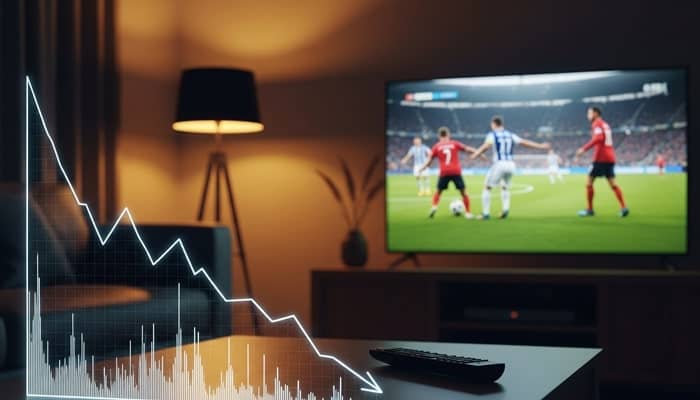
The Premier League, often hailed as the world’s most entertaining and unpredictable football league, has long been a golden goose for its broadcast partners. However, the latest viewing figures from the most recent season suggest a potential crack in the armor. After two consecutive record-breaking seasons, lead broadcaster Sky Sports saw its live viewership drop by a significant 10%, while TNT Sports experienced an even steeper 17% decline. While not yet a crisis, this downturn is a significant warning sign that has prompted a deeper analysis of the complex forces at play.
The decline is not a simple issue but rather the result of a perfect storm of factors, including a lack of on-pitch jeopardy, increasing broadcast saturation, the pervasive threat of illegal piracy, and powerful off-pitch economic pressures facing consumers. This deep dive explores the interconnected challenges that are testing the unwavering dominance of the Premier League in the modern media landscape.
The Power of Narrative: Why a Lack of Jeopardy Hurts Ratings
At its core, the appeal of any sports league is built on narrative and suspense. The week-to-week drama of a nail-biting title race or a desperate relegation battle is what transforms regular season matches into “must-watch” television events for millions of neutral fans. The most recent season, however, was conspicuously lacking in this crucial element. Liverpool comfortably secured the league title on April 27th, while the relegation places were decided the day before. With the league’s biggest questions answered weeks before the final day, the competitive tension evaporated.
This stands in stark contrast to the two previous, record-breaking seasons where Manchester City and Arsenal battled for the title until the very end. When the outcome of the league is a foregone conclusion, the stakes for individual matches plummet. Broadcasters like Sky noted that while viewing figures tracked closely with the previous year for much of the campaign, there was a sharp drop-off over the final six weeks. This directly correlates with the period when the title race fizzled out. Without the suspense of a final-day decider or a dramatic “great escape” at the bottom of the table, a significant portion of the casual viewing audience simply tuned out, proving that a compelling story is the most valuable commodity a sports league can offer.
Broadcast Saturation: Drowning in a Sea of Football?
Another significant factor potentially diluting the Premier League’s audience is the sheer volume of football now available to viewers. The concept of “broadcast saturation” suggests that when consumers are presented with an overwhelming amount of choice, the audience for any single product can become fragmented. This theory is particularly relevant given Sky’s new, monumental deal with the English Football League (EFL), which sees the broadcaster showing more than 1,000 live games per season from the leagues below the Premier League.
While this is fantastic for fans of the EFL, it means that on any given weekend, Premier League fixtures are no longer the only high-quality option available. A viewer now has multiple live matches competing for their attention at any one time. This problem of choice is set to intensify. The Premier League’s new domestic broadcast deal, worth a record £6.7 billion, will see even more live matches on TV, with Sky’s allocation rising from 128 to at least 215 games per season. This raises a critical question: will more games attract a larger total audience, or will it simply spread the existing audience even thinner, further depressing the average viewing figure for each individual match?
The Piracy Pandemic: Fighting a War on an “Industrial Scale”
Lurking in the shadows of the official broadcast figures is the ever-growing threat of illegal streaming. Piracy is no longer a niche activity; it is a sophisticated, mainstream competitor operating on what has been described as an “industrial scale.” For many potential subscribers, the high and often rising cost of legitimate sports packages is the primary driver towards illegal alternatives. To legally watch every Premier League game, a fan in the UK often requires separate, expensive subscriptions to multiple services like Sky Sports and TNT Sports.
Illegal streaming services, by contrast, often offer every single game from every league in one place for a fraction of the cost, or even for free. This creates a powerful incentive that is difficult for legitimate broadcasters to compete with. The heads of major rights holders have warned that this trend is causing a “financial crisis” in the industry. It creates a vicious cycle: broadcasters pay billions for rights, pass that cost onto the consumer through higher subscription fees, and in doing so, inadvertently push more price-sensitive viewers towards illegal streams. This “unseen” viewership doesn’t appear in official ratings but represents a massive and growing hole in the revenue bucket for both the Premier League and its partners.
A Look to the Future: The Premier League’s £6.7bn Gamble
The confluence of these issues makes the Premier League’s new £6.7 billion domestic television deal a fascinating and high-stakes gamble. The record-breaking fee is built on the assumption that the league’s commercial value and audience appeal will continue its relentless upward trajectory. However, the recent dip in viewing figures, albeit from a very high peak, serves as a timely reality check. The league and its broadcast partners are now facing a more complex landscape than ever before.
They must contend with the natural ebb and flow of on-pitch narratives, a saturated media market where they compete not just with other sports but with a vast array of entertainment options, and the persistent, tech-driven challenge of piracy. While the Premier League remains a titan of global sports entertainment, the latest figures are a clear reminder that its continued success is not guaranteed. Navigating these headwinds will require a delicate balance of providing compelling sporting drama while ensuring the product remains accessible and valuable to the fans whose loyalty underpins the entire enterprise.