The National Football League is in a constant state of evolution. Every offseason, the league’s competition committee and team owners meet to debate, refine, and implement new rules designed to improve the game. The changes for the 2025 season are a fascinating reflection of the league’s current priorities, touching on everything from one of the sport’s most controversial plays to the strategic nuances of special teams and the very fabric of overtime.
These adjustments are a delicate balancing act, aiming to enhance player safety, increase entertainment value, and ensure competitive fairness. As teams and fans prepare for the upcoming season, understanding these new rules is essential. This definitive guide breaks down every significant rule change, from the survival of the “tush push” to the overhaul of onside kicks, and analyzes the strategic implications they will have on the field.
The “Tush Push” Survives a Contentious Debate
No play in modern football has generated more debate than the “tush push” or “Brotherly Shove,” a quarterback sneak popularized and perfected by the Philadelphia Eagles. The play, which involves multiple players pushing the quarterback from behind to gain a short-but-critical yard, has proven to be almost unstoppable. Its effectiveness led to a fierce debate among team owners, with some, like the Green Bay Packers, pushing for it to be banned, citing concerns over player safety and competitive imbalance. Critics argued that the play was more akin to a rugby scrum than a traditional football play and that it created dangerous piles of bodies.
However, proponents, led by the Eagles, argued that it was simply a well-executed, physical football play that should not be legislated out of the game. In the end, the Eagles got their way. In a vote at the owners’ meetings, the proposal to ban the play fell just two votes short of the 24 required for it to pass. The survival of the tush push is a significant victory for teams with strong offensive lines and powerful quarterbacks. It ensures that for the 2025 season, one of the most effective and controversial short-yardage weapons in the league will remain a legal and crucial part of offensive strategy.
A Strategic Overhaul: Onside Kicks and Touchbacks
The NFL has made two significant changes to its special teams rules, both aimed at encouraging more strategic decision-making and exciting returns. The first is a major alteration to the onside kick policy. Previously, teams could only attempt a declared onside kick in the fourth quarter. Under the new rule for 2025, a trailing team can now declare an onside kick at any point during the game. This could lead to fascinating new strategies, potentially allowing a team that falls behind by two scores early in a game to attempt a surprise onside kick to regain momentum, rather than waiting until the final, desperate minutes.
In a corresponding move designed to increase the number of kick returns, the league is also changing the touchback rule. After a successful trial in 2024 where touchbacks were moved to the 30-yard line, the starting position will now be moved even further up, to the 35-yard line. This creates a significant disincentive for receiving teams to simply take a knee in the end zone. The league hopes this will dramatically increase the kick return rate from around 33% to between 60-70%. Together, these two changes are designed to inject more excitement and strategic variance into a phase of the game that has often become predictable.
Fairness in Overtime: Both Teams Guaranteed a Possession
One of the most fan-friendly rule changes is the official adoption of the postseason overtime format for all regular-season games. This ensures that both teams will be guaranteed at least one possession in overtime. This change is a direct result of the controversy surrounding the classic 2022 AFC Divisional Playoff game between the Kansas City Chiefs and the Buffalo Bills, where the Chiefs won the coin toss and scored a touchdown on the opening drive, meaning the Bills’ high-powered offense never got to touch the ball.
That game sparked a league-wide conversation about the fairness of the previous “sudden death” format. The NFL subsequently changed the rule for the postseason, and after a successful trial period, it will now be the standard for all games. Under the new format, if the first team scores a touchdown, the other team still gets a possession to try and match it. If the score is still tied after both teams have had the ball, the game then reverts to true sudden death, where the next score of any kind wins. This ensures a more equitable and exciting conclusion to tied games.
Technology and Transparency: Hawk-Eye, Replay, and Olympics
The league is continuing to embrace technology to improve accuracy and speed. For 2025, Sony’s Hawk-Eye camera system will be used to measure for first downs, effectively replacing the on-field chain gang in crucial situations. This system, which uses multiple 8K cameras to pinpoint the ball’s location, is expected to be faster and more accurate than manual measurements. While the traditional chain gang will still be used in a secondary capacity, this is a major step towards modernizing one of the sport’s oldest procedures.
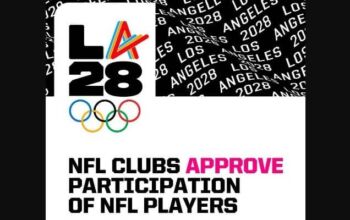
The scope of replay review has also been expanded. Officials can now review penalties such as hits on a defenseless player, facemasks, and horse-collar tackles, provided a flag was thrown on the field. This allows coaches to challenge what they believe to be an incorrect penalty call, adding another layer of oversight. Finally, in a landmark move for global expansion, team owners have unanimously voted to allow NFL players to participate in the flag football event at the 2028 Los Angeles Olympics. This opens the door for a potential “Dream Team” of NFL superstars to compete for Olympic gold, a massive opportunity for the league to showcase its talent on the world’s biggest sporting stage.