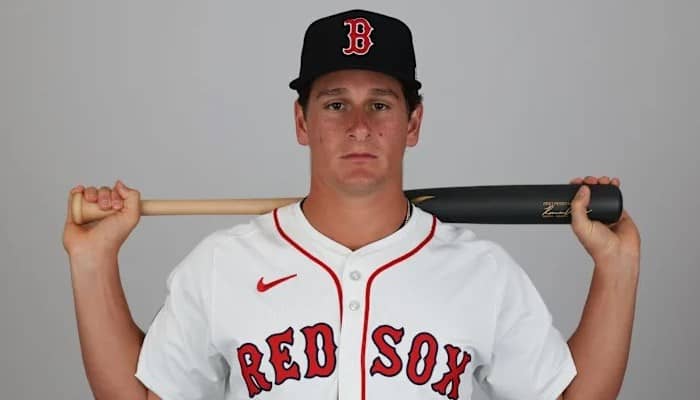
It is a moment that every baseball fanbase eagerly awaits: the arrival of a true, can’t-miss prospect. For the Boston Red Sox, that moment has finally come. After months of anticipation and Triple-A dominance, 21-year-old outfielder Roman Anthony, the consensus number one prospect in all of baseball, has officially been called up to the Major Leagues. His debut immediately makes him the youngest player in “The Show,” and he brings with him the kind of stratospheric offensive ceiling that can change the trajectory of a franchise.
His first few games have already offered a tantalizing glimpse of the special talent he possesses. But what exactly makes him such a big deal? This deep-dive analysis explores the journey, the unique offensive profile, and the potential future stardom of the player the Red Sox hope will be the next great Fenway Park icon.
The Offensive Profile: Elite Power Meets Elite Patience
The foundation of Roman Anthony’s value lies in his bat, which has the potential to be truly special. He is a supreme athlete in the batter’s box, possessing a rare combination of explosive power and remarkable plate discipline. The power is undeniable. While still in Triple-A, he launched a colossal 497-foot grand slam, the longest home run recorded in professional baseball this year. His raw bat speed is already elite, ranking in the 87th percentile of all MLB players through his first two games—placing him in the same company as established superstars like Bryce Harper and Bobby Witt Jr. This isn’t just potential; it is present-day, top-of-the-scale power that is ready to compete at the highest level.
What makes this power so intriguing is that it is paired with an incredibly passive approach at the plate. Anthony rarely swings. His swing rate over the past three seasons has hovered between 35-38%, a figure that would place him in the bottom five of all qualified MLB hitters. For context, the only player with a lower swing rate than Anthony’s mark in Triple-A this year was Juan Soto, a player renowned for having arguably the best batting eye in baseball. This combination of patience and power is a nightmare for opposing pitchers. He forces them to come into the strike zone, and when they do, he has the explosive bat speed to do massive damage. This unique profile is the primary reason scouts believe his offensive ceiling is so incredibly high.
The Journey: From “Tweener” to Baseball’s Top Prospect
Anthony’s ascent to the top of the prospect rankings has been nothing short of meteoric. When he was drafted 79th overall in 2022, he was a well-regarded high school talent, but he was not considered a “can’t-miss” prospect. In fact, many talent evaluators worried he might be a “tweener”—an outfielder who didn’t possess the elite defensive skills to be a long-term center fielder, but who might not hit for enough power to profile as a classic corner outfielder. There were concerns that his ultimate ceiling might be that of a solid but unspectacular fourth outfielder.
However, upon entering professional baseball, Anthony immediately shattered those labels. His power potential, contact ability, and advanced swing decisions far exceeded expectations. He dominated High-A baseball in 2023 as one of the youngest players in the league, but his true breakout came a year later when he slashed an incredible .291/.396/.498 across Double-A and Triple-A. This performance propelled him from a solid prospect to the consensus number one talent in the entire sport. His rapid development and his obliteration of every challenge put in front of him is a testament to both his natural talent and his work ethic, turning a player with questions into the most exciting young hitter in the game.
The Projections: What Kind of Player Could He Become?
When projecting a prospect with Anthony’s unique skill set, analysts point to several established All-Stars as potential career paths. The ultimate ceiling comparison is Houston’s Kyle Tucker or the peak MVP-version of Christian Yelich. Like those two players, Anthony has the potential to be a true five-tool threat who hits for both average and power while adding value on the basepaths. However, like Yelich, Anthony has shown a tendency to hit a high number of ground balls. His 52.2% ground ball rate in Triple-A is a figure he will need to improve upon to consistently tap into his immense raw power. Thankfully, like other successful high-ground-ball hitters such as Fernando Tatis Jr. and Gunnar Henderson, Anthony hits the ball so hard that he can still find success even without optimizing his launch angle.
If his transition to the big leagues is seamless, his performance could mirror the immediate impact of Detroit’s Riley Greene. If it takes him a bit more time to adjust and for his contact ability to stabilize against elite pitching, a trajectory similar to that of the Yankees’ Jasson Domínguez could be expected. While his athleticism is currently a plus, if he fills out his frame and loses a step as he ages, a reasonable comparison could be a power-hitting corner outfielder like a prime Jay Bruce or Brandon Nimmo. The range of outcomes is wide, but every single one points to a valuable and impactful Major League player.
The Fit in Boston: A Cornerstone for the Future
The fact that it took an injury for the Red Sox to finally call up their top prospect speaks more to the established nature of their big-league roster than to any doubts about Anthony’s readiness. The outfield was set with Jarren Duran, Ceddanne Rafaela, and Wilyer Abreu. An injury to Abreu was the catalyst that finally opened the door for Anthony’s promotion. Now that he has arrived, the long-term picture becomes both more exciting and more complicated.
The immediate question is how he fits into the lineup once Abreu returns. Does Anthony’s performance force the team to make a difficult decision? Do they consider moving the defensively versatile Rafaela to the infield to open up a permanent outfield spot? Or does Anthony’s arrival make another outfielder, like the oft-rumored Jarren Duran, a more expendable trade chip? These are the kinds of difficult but good problems that the arrival of a blue-chip prospect creates. While the short-term defensive alignment remains murky, one thing is clear: with the arrival of Roman Anthony, the future of the Boston Red Sox has arrived, and it promises to be incredibly exciting.