A memorable and controversial clash between Max Verstappen and George Russell at the Spanish Grand Prix saw the Red Bull driver handed a significant penalty, a decision that FIA steward Derek Warwick has since analyzed and defended as the “perfect” course of action. While some critics called for Verstappen’s disqualification, Warwick provides an expert’s insight into the stewards’ ruling, explaining the critical nuances of the decision.
This analysis revisits the high-profile incident, the penalty that dropped Verstappen down the order, and the ongoing debate surrounding the conduct of both drivers and FIA officials.
Revisiting the Spanish GP Clash: What Happened?
The explosive moment on track had its roots in a team instruction. The incident was triggered after Verstappen was asked by his Red Bull team to give his position to Mercedes’ George Russell, having cut the track at Turn 1 to maintain his lead.
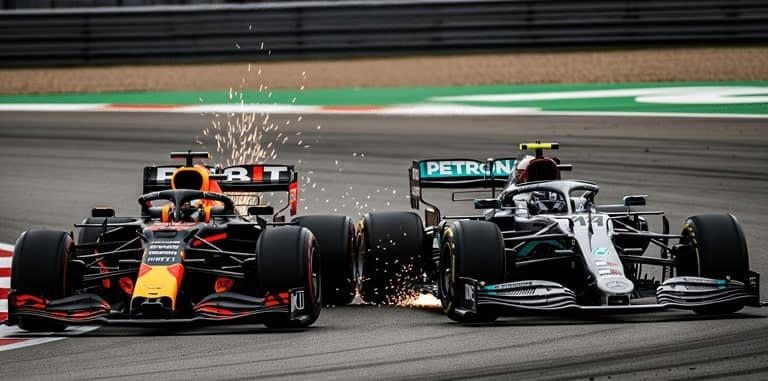
Complying with the directive, Verstappen slowed his car on the approach to Turn 5 to allow Russell to overtake. However, in a contentious move, Verstappen then accelerated into the corner, making firm and decisive contact with the side of the Mercedes. The collision was a clear breach of conduct and immediately drew the attention of race control.
The Stewards’ Decision: A Costly Penalty for Verstappen
The race stewards acted swiftly to address the incident. They issued Max Verstappen a 10-second time penalty for causing a collision.
Consequently, this punishment had a major impact on the final race classification. Verstappen, who crossed the line in fifth place, was demoted to 10th after the penalty was applied. In addition to the time lost, he was also handed three penalty points on his super license, a serious sanction that pushed the reigning four-time World Champion closer to a potential one-race ban.
Derek Warwick’s Analysis: Why the Penalty Was ‘Perfect’
Derek Warwick, a respected figure in motorsport with 147 Formula 1 starts and a Le Mans 24 Hours victory to his name, regularly serves as an FIA steward. He weighed in on the Verstappen-Russell incident, defending the final ruling.
“Should he have done what he did, in Turn 5 with George Russell? Absolutely not,” Warwick stated firmly. “Did he get a penalty for that? Yes.”
To explain why the penalty wasn’t a disqualification, Warwick compared it to a past event. “Sebastian Vettel was once given a 10-second drive-through penalty in Baku after an incident with Lewis Hamilton [in 2017], but he deliberately drove into Lewis,” he noted. “Whereas if you watch this video, it seems to me that although he dove in, he then did turn away from George, but momentum pushed him against George. It is absolutely wrong and the FIA was right to give him a penalty.”
Despite acknowledging that some felt a suspension was warranted “as an example to young karters,” Warwick concluded, “I think the penalty was perfect. You have to look at each incident individually.”
A Wider Debate: Steward Neutrality and Media Commentary
Warwick’s comments, which were made to the gambling platform Plejmo, touch upon a sensitive and recurring issue in Formula 1: the potential for a conflict of interest among FIA stewards.
This context is crucial, as it mirrors a past controversy involving three-time F1 race winner Johnny Herbert. Herbert’s position as a steward came under scrutiny after he penalized Verstappen and later criticized the driver’s “horrible mindset” in an article for a gambling website.
The situation led to Herbert being dropped from his role in January, with FIA President Mohammed Ben Sulayem explaining that a steward cannot simultaneously act as a referee and express strong personal opinions as a media pundit. Warwick’s public analysis brings this important debate about official neutrality back into the spotlight.